Olympus OM 35mm film system close-up and macro equipment
Trans-Illuminator Base X-DE
Introduction
This base was originally designed for use with Olympus stereo microscopes of the 1970s, and was supplied as standard equipment with the X-Tr model, with its own wooden box that also held the arm rests. It can also be used with the SZ, SZ-III, SZ-Tr, VT-II and X microscopes. It was also sold as part of the OM system for use with the Macrophoto Stand VST-1, which fits neatly on top of the base (although it overhangs at the rear) and locates on two raised screws at the front. It has three smooth rubber feet, to prevent wobbling and to prevent damage to work surfaces.
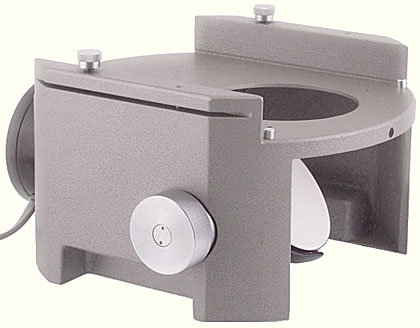
Olympus OM Trans-Illuminator Base X-DE
| Microscope ref. | X-DE, 5-S150 |
|---|---|
| US stock no. | 104-141 (20w), 104-140 (30w) |
| Introduced | 1972 |
| Discontinued | |
| 1978 US price | $150.00 (20w), $400.00 (30w) |
| 1988 US price | $288.00 (20w) |
| 1978 UK price | £58.00 + VAT (20w) |
| Bulb ref. | 8-S250 |
| Bulb spec. | ES, F240V/20W or F120V/20W, globe diameter 34.5 mm |
The supplied mirror is reversible, with one side flat and glossy white, and the other a plano-cylindrical mirror. The mirror is fitted in a semi-circular black mount that allows it to be adjusted in two planes. A large, knurled knob on the left side of the base allows the mirror to be adjusted about a horizontal axis, and it can also be swivelled within its mount. The curved mirror is intended for use with microscopes, and does not provide uniform illumination. The white side provides uniform illumination, suitable for photography, but less bright.
The four threaded holes on the top plate and the small hole in the front of the top plate are not mentioned in the OM documentation. They are for attaching the Aperture Iris Diaphragm.
The X-DE is not marked “Olympus”; only the lamp housing is marked “Olympus”.
Accessories
Lamp housing
The lamp housing is cylindrical, and is a friction fit in a tube at the rear of the stand. The housing can be slid backwards and forwards to provide a measure of control over the illumination. When brighter illuminaton is needed, the housing can be removed by sliding it out, allowing the Trans-Illuminator LSD to be positioned behind the stand.
Bulbs
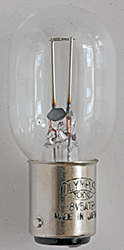
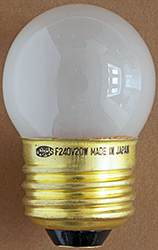
The bulbs for the common 20W version (left picture) were frosted, with a tungsten filament and a 27 mm ES screw fixing, F240V/20W or F120V/20W, globe diameter 34.5 mm.
These 20W bulbs (type 8-S250) can be replaced by larger, modern LED bulbs that are brighter, last longer and do not get very hot.
The bulbs for the uncommon 30W version (right picture) were the same as the ones used in the Trans-Illuminator PM-LSD and the Epi-Illuminator PM-LSD 2.
The 30W bulbs were low voltage and so they needed one of the transformers.
Arm rests
For the OM system, the polished wooden hand rests that can be fitted on each side were optional. Each hand rest has a metal plate with two L-shaped holes. On each side of the top of the base there is a horizontal slot into which the metal plate fits. The slot has one fixed metal rod, and a second metal rod that can be screwed in and out with a milled knob.
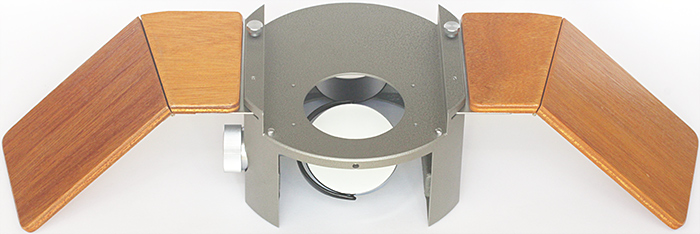
Wooden arm rests for X-DE
To fit an arm rest:
- Unfold the arm rest, with the hinge underneath.
- Partially unscrew the milled knob, so that the metal rod is clear of the horizontal slot.
- Slide the metal plate of the arm rest into the horizontal slot, so that one of the L-shaped holes fits over the fixed metal rod.
- Move the arm rest backwards or forwards to engage the L-shaped hole on the fixed metal rod.
- Screw in the milled knob so that the metal rod passes through the other L-shaped hole.
To remove an arm rest:
- Partially unscrew the milled knob, so that the metal rod is clear of the horizontal slot.
- Slide the arm rest backwards or forwards so that it disengages from the fixed metal rod.
- Pull the arm rest sideways so that the metal plate comes out of the horizontal slot.
The arm rests are not marked “Olympus”.
Wooden box
When purchased as part of the standard equipment for the X-TR stereo microscope, the trans-illuminator base was supplied in a fitted wooden box that also held the arm rests.
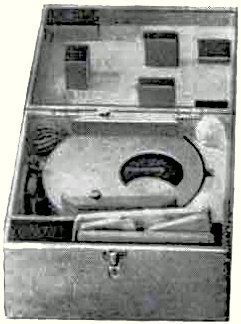
Wooden box for X-DE
Centering Mirror PM-ELCS
The supplied mirror can be removed, and replaced by the Centering Mirror PM-ELCS, which has a flat mirrored surface and can provide even illumination. This flat-surfaced mirror is essential for use of the Lieberkühn reflectors.
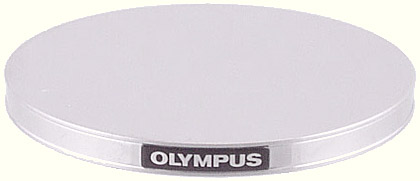
Olympus OM Centering Mirror PM-ELCS
To change the mirror (taking care not to get finger marks on it):
- Remove the arm rests and the lamp housing.
- Turn the base upside-down.
- Turn the large milled knob on the side of the base so that the black semi-circular mount holding the mirror is vertical.
- Turn the mirror so that it is at right-angles to the mount.
- Hold the mirror by the sides furthest from the mount.
- Pull the top side of the mount upwards, while pushing the mirror downwards and tilting it so that it comes off the mount.
- Note the two small holes in the perimeter of the mirror, where the mount locates.
- Position the other mirror so that one of the small holes locates on the bottom side of the mount.
- Pull the top side of the mount upwards, while pushing the mirror downwards and tilting it so that the other small hole locates on the top side of the mount.
- Turn the base the right way up, and re-fit the lamp housing and the arm rests.
Aperture Iris Diaphragm
Brochures and instructions for some Olympus stereo microscopes describe and illustrate an optional Aperture Iris Diaphragm that could be used to control the diameter of the light beam or to provide oblique illumination.
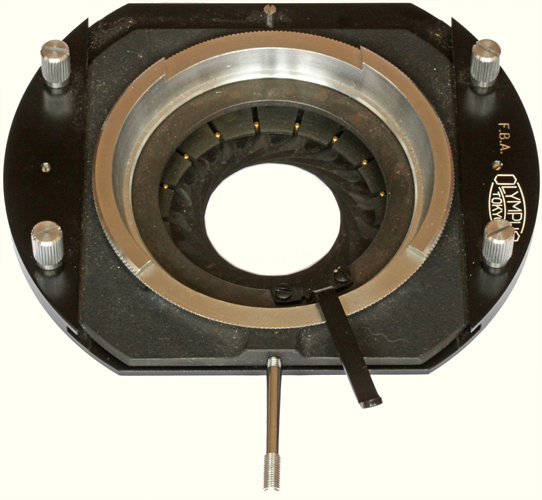
Aperture Iris Diaphragm
It is attached under the top plate of the X-DE with four screws. The lever for moving the iris diaphragm in and out for oblique illumination has to go through the small hole in the front of the top plate.
Versions
The version of the X-DE that was sold for use with the OM system is finished in a “hammered” medium grey, similar to the grey parts of the Auto Bellows and various other OM macro equipment.
There are two other versions, differing only in the colour and finish of the non-chrome metallic body parts, designed to match Olympus microscopes of various vintages. The older version is finished in a smooth, glossy grey, and the newer version (X-DE-W, 5-S150W) is finished in a smooth, semi-matt cream.
Most examples use a mains-voltage 20-watt ES-fitting bulb and have an 1800 mm mains lead. A few examples exist with a 6-volt 30-watt bulb housed in a ventilated lamp house and powered from a separate transformer, as shown in early editions of the Sales Information File.
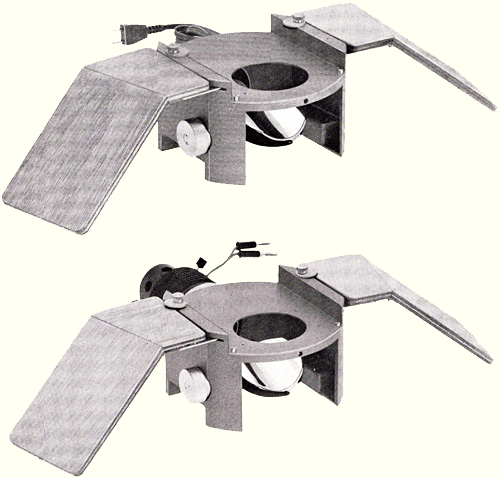
Versions of X-DE Base
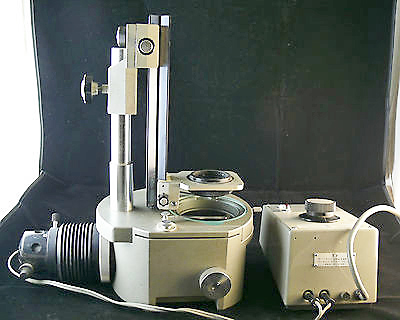
X-DE Base with 30W lamp
A few examples exist with a 24-volt 30-watt bulb; it is not known if these were supplied by Olympus or whether they have been modified by enthusiasts.
Instruction leaflet
Instructions were not provided with the Trans-Illuminator Base.
Send comments or questions to Alan Wood

Created 18th May 2001 — Updated 13th April 2026
Copyright © 2001–2026 Alan Wood