Olympus OM 35mm film system close-up and macro equipment
Focusing screens
Introduction
The focusing screens can only be used with the single-digit OM camera bodies – OM-1(N), OM-2(N), OM-2SP, OM-3(Ti) and OM-4(Ti); the focusing screen in the SC 35, OM-10, OM-20, OM-30 and OM-40 is not interchangeable.
The screens were supplied in small polythene bags in a hard plastic case. The case has a spring clip to hold the screen in place, and a groove that can support the screen on its side. The case also contained a cleaning brush and a special tool for gripping the small tab of the screen.
- Focusing Screen 1-4
- Focusing Screen 1-4N
- Focusing Screen 1-8
- Focusing Screen 1-10
- Focusing Screen 1-11
- Focusing Screen 1-12
- Focusing Screen 2-4
The screen numbers are marked on the small tab.
The series 2 screens, such as the 2-4, have a larger locating tab that was intended to restrict them to use in the OM-2SP, OM-3, OM-3Ti, OM4 and OM-4Ti camera bodies.
Versions
Only one version of each screen is known.
There are two versions of the cleaning brush. The earlier version has a solid, black handle and black bristles. The later version has a hollow, white, translucent handle and white bristles.
There are at least 3 versions of the plastic box. The oldest version has a compatibility table on its base for the 1, 2, 3, 4, 5, 6, 7, 11 and 12 screens. The middle version has a more comprehensive compatibility table that includes the 8, 9 and 10 screens. The latest version does not have a compatibility table on its base.
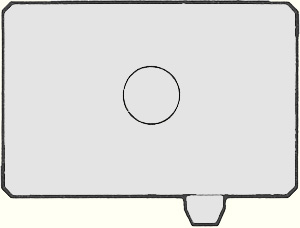
Focusing Screen 1-4
Matte. Replaced by the 1-4N screen, in which the size of the centre circle was reduced to match the size of the spot-meter area in the OM-4 camera body.
|
 |
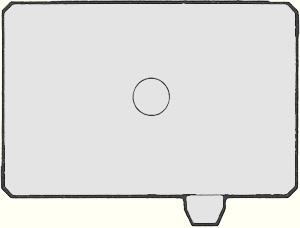
Focusing Screen 1-4N
Matte. Replacement for the original 1-4 screen, with the size of the centre circle reduced to match the size of the spot-meter area in the OM-4 camera body.
|
 |
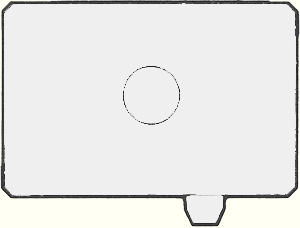
Focusing Screen 1-8
Fine matte. Similar to the original 1-4 screen, but with a finer matte surface. Originally intended for astrophotography, but also suitable for close-up photography.
|
 |
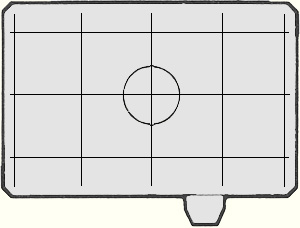
Focusing Screen 1-10
Matte with etched horizontal and vertical lines. Similar to the original 1-4 screen, but with three horizontal and five vertical lines. There is a central vertical line, with the other vertical lines 7 mm and 14 mm from it. There is a central horizontal line, with the other horizontal lines 7 mm from it. Originally intended for use with the shift lenses, but found to be useful for composition and for keeping horizontal and vertical lines in the subject.
|
 |
Focusing Screen 1-11
Fine matte plus cross-hairs. Similar to the 1-8 screen, but with a small, clear centre circle with double cross-hairs for precise focusing of an aerial image. Intended for use with the Zuiko Auto-Macro 38 mm f/2.8, Zuiko Macro 38 mm f/3.5, Zuiko Auto-1:1 Macro 80 mm f/4 and Zuiko 1:1 Macro 80 mm f/4 lenses.
|
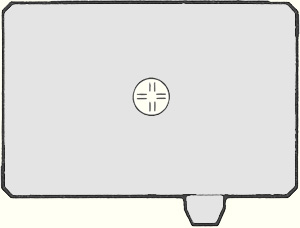 |
Focusing with the cross-hairs needs a different technique (no-parallax) from focusing on the matte area.
- Temporarily put the image in the viewfinder out of focus.
- Make sure that you can clearly see the double lines of the cross-hairs. If necessary, adjust the viewfinder of the OM-4, or use a correction lens in an eyecup, or use the Varimagni Finder and adjust its eyepiece.
- Focus the image until both the image and the cross-hairs appear sharp.
- Move your head slightly from side to side. If the image and the cross-hairs do not move in relation to each other, then the image is focused correctly.
- If the image and the cross-hairs move in relation to each other, then adjust the focus until they do not.
Focusing Screen 1-12
Clear plus cross-hairs. No matte surface. The central circle is larger than in the 1-11 screen, and the cross-hairs are longer and finer. This screen gives a very bright image in the viewfinder, even brighter than the 2-4 screen, and gives the false impression that there is lots of depth of field. Intended for use with the Zuiko Auto-Macro 20 mm f/2, Zuiko Macro 20 mm f/3.5, Zuiko Auto-Macro 38 mm f/2.8 and Zuiko Macro 38 mm f/3.5 bellows macro lenses, and for photomicrography.
When the Focusing Screen 1-12 is used with the Varimagni Finder for photomicrography, the Eyecoupler should be used between the camera’s eyepiece and the Varimagni Finder, in order to prevent cut-off at the corners of the image in the viewfinder.
|
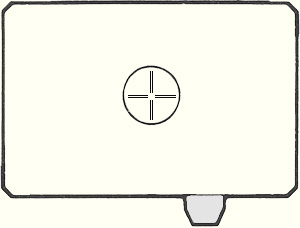 |
Focusing with this screen must be carried out using the no-parallax method, which is different from focusing on a matte screen.
- Temporarily put the image in the viewfinder out of focus.
- Make sure that you can clearly see the double lines of the cross-hairs. If necessary, adjust the viewfinder of the OM-4, or use a correction lens in an eyecup, or use the Varimagni Finder and adjust its eyepiece.
- Focus the image until both the image and the cross-hairs appear sharp.
- Move your head slightly from side to side. If the image and the cross-hairs do not move in relation to each other, then the image is focused correctly.
- If the image and the cross-hairs move in relation to each other, then adjust the focus until they do not.
This screen is also fitted in the SC 35 Type 12 microscope camera.
Focusing Screen 2-4
Matte. Similar to the 1-4N screen, but approximately 2 stops brighter. Has a larger locating tab, intended to restrict it to use in the OM-2SP, OM-3, OM-3Ti, OM4 and OM-4Ti camera bodies.
|
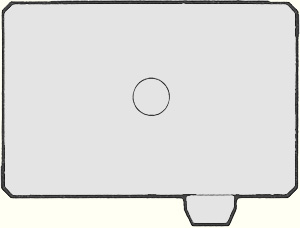 |
The tab can be clipped or filed down to fit in the earlier bodies, and will give correct automatic TTL exposure in the OM-2 and OM-2N bodies.
Instruction leaflet
FOCUSING SCREEN
| 1-1 | 1-2 | 1-3 | 1-4N | 1-5 | 1-6 | 1-7 | 1-8 | 1-9 | 1-10 | 1-11 | 1-12 | 1-13 | 1-14 | 2-4 | 2-13 | ||
|---|---|---|---|---|---|---|---|---|---|---|---|---|---|---|---|---|---|
| Macro 50mm (F2) | △ | △ | |||||||||||||||
| Macro 50mm (F3.5) | △ | ||||||||||||||||
| Macro 90mm (F2) | △ | △ | |||||||||||||||
| Macro | 20mm | * | * | * | * | * | * | * | * | * | |||||||
| 38mm | * | * | * | * | * | * | * | ||||||||||
| 80/135mm | * | * | * | * | * | * | * | ||||||||||
| Photo Micro Graphy | |||||||||||||||||
| Compatible. | |
| * | Compatible. In marked combinations microprism, split-image prism and edges of the finder will darken. |
| △ | Compatible. In marked combinations the built-in exposure meter of the OM-1(N) and OM-2(N) will not indicate correct exposure. |
| The 2-4 and 2-13 cannot be mounted on the OM-1(N) or OM-2(N). |
Instruction leaflet (January 1995)
Instruction leaflet (October 1978)
Sales Information File
Send comments or questions to Alan Wood

Created 18th May 2001 — Updated 19th April 2026
Copyright © 2001–2026 Alan Wood